
UST compliance: 40 CFR 280, Part 613, county programs and VA DEQ
Underground storage tank compliance is a set of equipment standards, testing schedules and records that an owner or operator has to keep current for as long as the tank is in the ground. The federal rule at 40 CFR 280 sets the floor. New York's 6 NYCRR Part 613 and Virginia's 9VAC25-580 adopt it with state additions. On Long Island and in Westchester, county programs add their own permits, testing and containment requirements on top of that.
At a glance
Managing Member · B.S. Civil Engineering, Georgia Tech · 15+ years in fuel systems · Updated September 2026
Most UST compliance failures are not leaks. They are failed spill bucket and sump tests, overfill devices that were never verified, monitoring records that were never kept, and operator training that was never documented. Some of those are fixed by a service call. Others, a failed containment sump for example, require a design and a permit before the repair can start. This page covers what the rules require, where facilities fall short, and which failures turn into a design and permit response.
Who this applies to
- Owners and operators of regulated USTs at service stations, fleet yards, transit facilities and municipal garages
- Diesel USTs serving emergency generators at hospitals, data centers, telecom sites and institutional buildings
- Facilities on Long Island and in Westchester where the county administers the UST program
- Virginia UST owners registered with DEQ under 9VAC25-580
- Buyers, lenders and contractors who need to know whether an existing UST system is in compliance
What 40 CFR 280 requires
The federal UST regulation was revised in 2015, and the added requirements have been fully in effect for several years. A regulated UST is one that, together with its connected piping, has 10 percent or more of its volume underground and stores a regulated substance such as gasoline, diesel or fuel oil. The rule excludes some tanks (very small tanks, on-premises heating-oil tanks, and small farm and residential motor fuel tanks are the common exclusions), but states and counties often regulate what the federal rule leaves out.
The core obligations of a regulated UST system:
- Operator training: designated Class A, Class B and Class C operators, trained and documented, with retraining when compliance problems are found
- Release detection: a method that can detect a release from any portion of the tank and piping, monitored at least every 30 days, with annual testing of the release detection equipment
- Spill prevention: a spill bucket or equivalent at each fill connection, tested every three years (or monitored double-wall spill buckets)
- Overfill prevention: an automatic shutoff device, overfill alarm or ball float, inspected every three years to confirm it is set and working
- Corrosion protection: cathodic protection or non-corrodible construction for steel tanks and piping in contact with the ground, with CP tested within six months of installation and every three years, and impressed-current systems inspected every 60 days
- Walkthrough inspections: every 30 days for spill prevention equipment and release detection, and annually for containment sumps and handheld release detection equipment, all logged
- Containment sump testing: every three years for sumps used for interstitial monitoring of piping, unless the sump is double-walled and the interstice is monitored
- Emergency generator USTs: the old release-detection deferral ended with the 2015 revision, so generator tanks now need release detection like any other regulated UST
- Financial responsibility, release reporting and corrective action, and permanent closure requirements
NYSDEC Part 613
New York's Petroleum Bulk Storage program at 6 NYCRR Part 613 was restructured in 2015 to align with the federal rule. A PBS facility is one with more than 1,100 gallons of combined petroleum storage capacity, counting USTs and ASTs together, and the state also regulates USTs that meet the federal definition regardless of facility size. Registration is filed with NYSDEC and renewed on a five-year cycle, and it has to be amended when tanks are installed, modified, closed or change product.
Part 613 carries the federal equipment, testing, walkthrough and operator training requirements and adds state-specific pieces: registration and fee requirements, inspection and recordkeeping expectations, color coding and labeling, tightness testing on schedules that depend on the tank's construction and monitoring method, and New York's fast spill reporting rule (generally within two hours of discovery to the NYSDEC Spill Hotline for a reportable release).
In Suffolk, Nassau and Westchester the county administers the PBS program under delegation from NYSDEC, so the county is the agency that inspects and cites, and the county's own code applies on top.
- PBS registration for facilities over 1,100 gallons combined and for federally regulated USTs; renewal every five years
- Federal equipment, testing, walkthrough and operator training requirements carried into state rule
- Tightness testing schedules that depend on tank construction and monitoring
- Reportable spills called in to the NYSDEC Spill Hotline, generally within two hours
- County administration in Suffolk, Nassau and Westchester
Not sure where you stand? Send what you have.
A photo, the notice, or a sentence about the site is enough to start. Matt reviews it personally and comes back with the likely path.
County programs on Long Island and in Westchester
Suffolk County's Article 12, Article XV of the Nassau County Public Health Ordinance and Westchester County's Article XXV each reach USTs that the state and federal rules treat more lightly, and each adds a permit layer that the state program does not have.
Suffolk County maintains an extensive local regulatory program for petroleum and hazardous-material storage facilities, reflecting the importance of protecting the groundwater aquifer system that serves as the County's sole source of drinking water. New USTs must be double-wall with interstitial monitoring, the county requires a Permit to Construct and a Permit to Operate, existing USTs are on a county testing schedule with certificates filed by an approved tester, and registration reaches nearly all petroleum tanks including waste oil. Heating-oil exemptions disappear inside an Article 7 groundwater management zone or water supply sensitive area. Nassau and Westchester require their own registrations and permits and run their own inspections.
- Suffolk: double-wall USTs with interstitial monitoring; Permit to Construct and Permit to Operate; county testing schedule; near-universal registration
- Nassau: county storage permit and installation permit under Article XV of the Nassau County Public Health Ordinance, with fire marshal review
- Westchester: Article XXV registration and work permit
- All three: county compliance is required in addition to NYSDEC registration, not instead of it
Virginia DEQ: 9VAC25-580
Virginia regulates USTs through DEQ under 9VAC25-580, which adopts the federal program with Virginia-specific registration, operator training, inspection and corrective action provisions. Regulated USTs are registered with DEQ, and Class A and Class B operators complete DEQ-recognized training. DEQ performs compliance inspections and issues findings when equipment, testing or records fall short.
Virginia's fire officials add a separate layer under the Statewide Fire Prevention Code, including operational permits for flammable and combustible liquid storage and permits for tank installation and removal. The Virginia Petroleum Storage Tank Fund can satisfy the federal financial responsibility requirement for eligible tanks and reimburse eligible cleanup costs, subject to the fund's rules and preapproval.
- DEQ registration and Class A/B operator training under 9VAC25-580
- Federal equipment, testing and walkthrough requirements with Virginia additions
- Fire official permits under the Statewide Fire Prevention Code
- Virginia Petroleum Storage Tank Fund for financial responsibility and eligible cleanup reimbursement
Common UST compliance failures
The findings ZE sees most often, roughly in order of frequency:
- Spill bucket fails the three-year hydrostatic or vacuum test, usually from cracked or separated buckets
- Containment sump (STP sump, dispenser sump or transition sump) fails its test: cracked fiberglass, failed penetration boots, water intrusion
- Overfill prevention valve never inspected, set at the wrong level, or removed during a repair
- Release detection not actually monitoring every part of the system: an ATG on the tank with no line leak detection, or sensors that were disconnected
- Monthly walkthrough and annual inspection logs missing or incomplete
- Cathodic protection never tested, or tested and failed with no follow-up
- Operator training not documented, or Class C operators on site with no Class A or B assigned
- Registration does not match the site: wrong capacity, wrong product, a tank that was removed, a tank that was added
- Generator USTs still relying on the old release-detection deferral
What triggers a design and permit response
Not every failure needs an engineer. A failed spill bucket at a modern double-wall fill is usually a like-for-like replacement by a qualified contractor, filed with the AHJ as the program requires. Some failures are different: the fix changes the system, and the AHJ will want to see a design and issue a permit before the work starts.
- Failed STP sump or dispenser sump: replacement usually involves excavation, new sump, new penetration fittings, re-piping the transition and re-establishing interstitial monitoring. In Suffolk and other county programs this is a permitted modification.
- Piping replacement or rerouting: any change to the product piping is a modification that requires design and, in most jurisdictions, a permit
- Adding release detection where none exists: sensor selection, ATG integration and sump configuration have to be designed
- Upgrading single-wall components in a jurisdiction that now requires double-wall
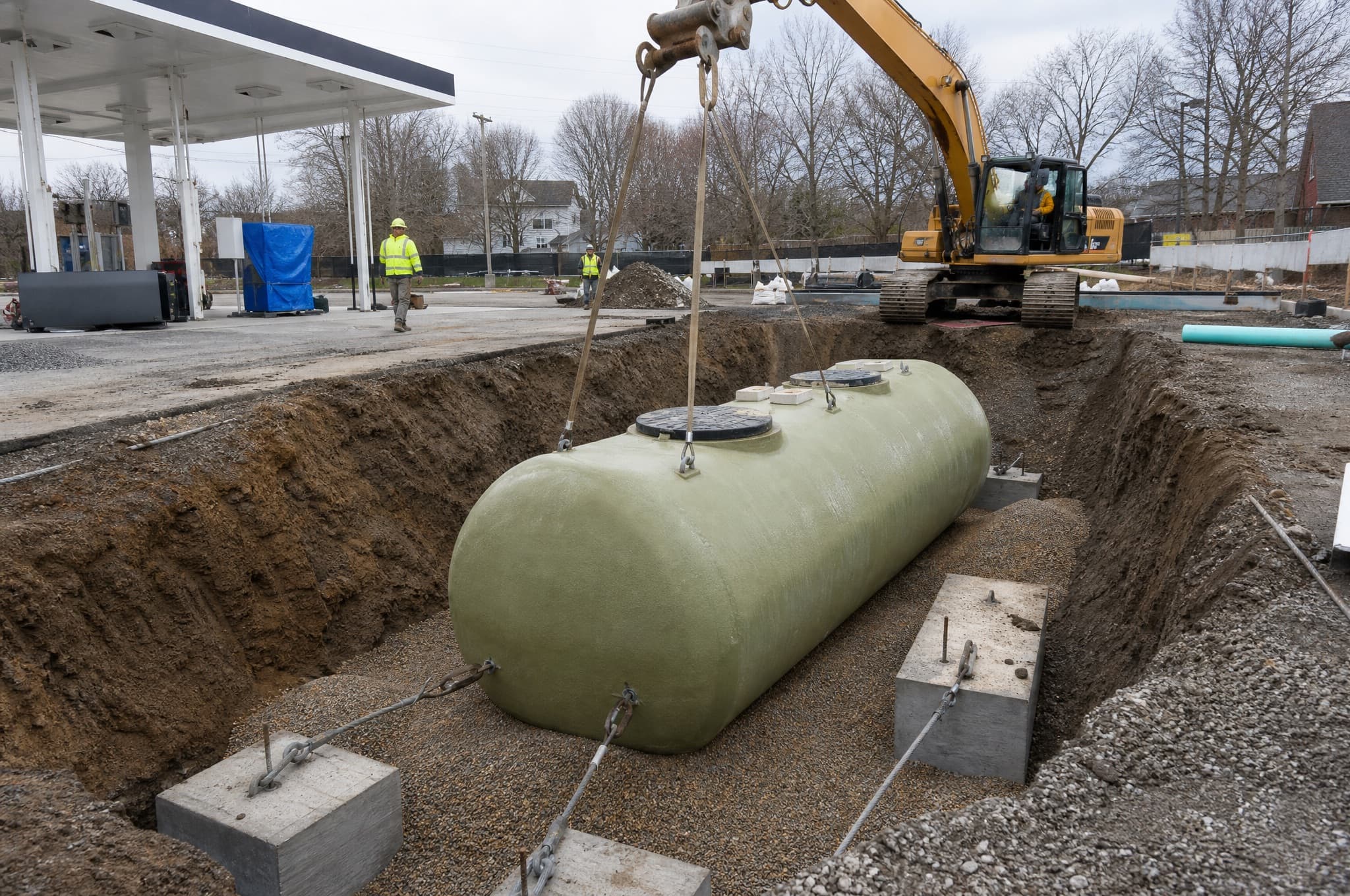
- Replacing the tank: a new installation, designed and permitted from the ground up, with the old tank closed properly
- UST-to-AST conversion: a new AST system designed to fire code and county requirements, plus closure of the UST
- Any correction cited in a Notice of Violation that changes equipment, containment or piping
How ZE supports UST compliance
ZE designs UST systems and corrections to the federal, state and county rules that apply at the specific site: tank, piping, sumps, spill and overfill equipment, release detection and the tank gauging interface. For existing systems, ZE investigates the failure, develops the compliance strategy, designs the correction, prepares the permit application, coordinates any required PE certification and supports the contractor through construction and AHJ inspection. Registrations with NYSDEC, DEQ and the county are updated as part of closeout.
- Compliance evaluation of an existing UST system against 40 CFR 280, Part 613 or 9VAC25-580 and the county code
- Design and permitting of sump replacements, piping corrections, release detection upgrades and tank replacements
- Violation resolution with a defined corrective path
- PBS and DEQ registration updates and county permit closeout
Common questions
How often do UST spill buckets, sumps and overfill devices have to be tested?
Under 40 CFR 280 as revised in 2015, spill prevention equipment and containment sumps used for interstitial monitoring of piping are tested every three years, and overfill prevention equipment is inspected every three years. Release detection equipment is tested annually. Walkthrough inspections are every 30 days for spill equipment and release detection and annually for sumps and handheld equipment. New York, Virginia and the county programs adopt these schedules and in some cases add their own tightness testing on top.
Our UST sump failed testing. What happens next?
A failed sump means the sump can no longer be relied on for containment or interstitial monitoring, and the AHJ will expect a correction on a defined timeline. If the sump is an STP sump or dispenser sump, replacement usually means excavation, a new sump, new penetration fittings and restored monitoring, which is a permitted modification in most jurisdictions. ZE designs the replacement, prepares the permit and supports the contractor through inspection. See the failed tightness test guide for the immediate steps.
Does my emergency generator diesel UST have to meet these rules?
In most cases, yes. The federal deferral that once excused emergency generator USTs from release detection ended with the 2015 revision, and generator USTs now need release detection like any other regulated tank. State and county programs regulate them as well; in Suffolk County the heating and standby-power exemption is narrow and disappears inside an Article 7 zone. Check the specific tank against the program that applies before assuming it is exempt.
Who is the Class A, B and C operator, and do I need all three?
Class A operators have overall responsibility for the facility's compliance, Class B operators handle day-to-day operation and maintenance, and Class C operators are the people on site who respond to alarms and emergencies. A regulated UST facility needs all three designated, with Class A and B trained through a program the state recognizes and Class C trained by the A or B operator. One person can hold more than one class. Documentation has to be on hand for the inspector.
Is the UST program different on Long Island?
Yes. Suffolk County administers the state PBS program and enforces its own Article 12 on top of it, with double-wall construction, interstitial monitoring, a Permit to Construct and Permit to Operate, a county testing schedule and near-universal registration. Nassau County runs its own storage ordinance through the Department of Health. In both counties the county is the agency that inspects and cites, and NYSDEC registration still has to be kept current.
Can ZE bring an existing UST system into compliance?
ZE evaluates the system against the rules that apply at the site, identifies what is deficient, and designs and permits the corrections. Where the correction is a modification, ZE prepares the permit application and coordinates any required PE certification. The contractor builds from the design, the AHJ inspects, and the registrations are updated. For systems that cannot be corrected at reasonable cost, ZE designs the replacement.
UST failing a test or an inspection?
Tell Matt Zambrano what failed and where the tank is. ZE will tell you whether the fix is a service call or a permitted modification, and design the path either way.