
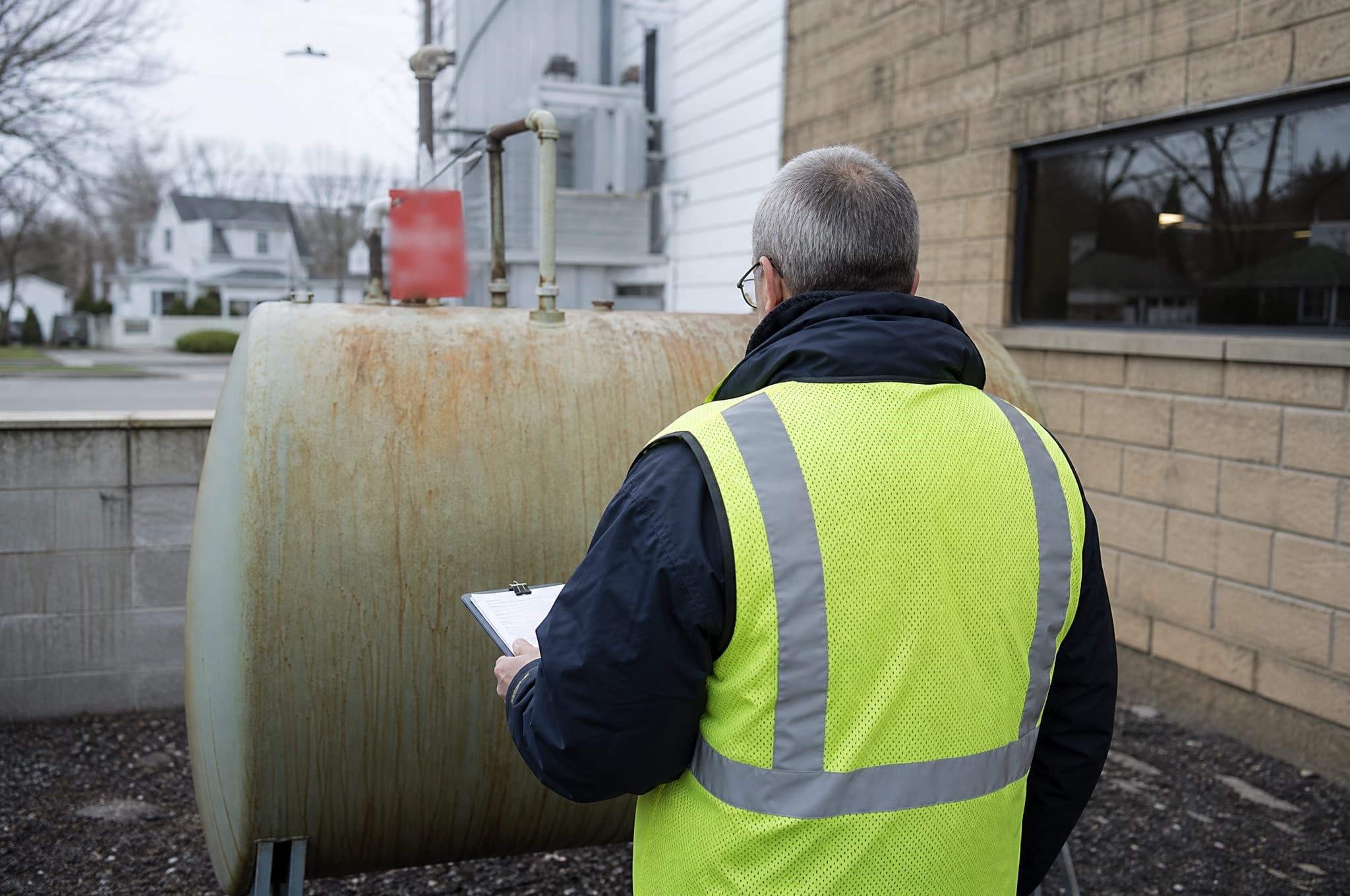
Fuel tank violations: what they are and how they get resolved
A petroleum storage violation is a written finding from an authority having jurisdiction that a tank system, or the records behind it, does not meet the code that agency enforces. It can arrive as a Notice of Violation after an inspection, a letter after a failed test result is filed, a stop-work order, or a hold on a certificate of occupancy. Most violations are not leaks. They are unregistered tanks, missing equipment, failed tests, expired permits and gaps in the paperwork that make an otherwise sound tank non-compliant.
At a glance
Managing Member · B.S. Civil Engineering, Georgia Tech · 15+ years in fuel systems · Updated September 2026
The notice usually gives a deadline and a list of cited code sections. It rarely explains what a compliant fix looks like, and it never says how to get the fix approved. That is the gap Zambrano Enterprises fills: investigate what the violation actually is, develop a compliance strategy, design the corrections, get them permitted and inspected, and close the file.
Who this applies to
- Owners and operators who received a Notice of Violation from a county health department, NYSDEC, Virginia DEQ or a fire marshal
- Facilities with a failed sump, spill bucket or tightness test that has been reported to the AHJ
- Property owners whose certificate of occupancy or sale is being held up by a tank finding
- Gas stations, fleet yards, repair shops and generator sites on an inspection cycle
- Buyers who inherited a violation with the property
- Contractors and engineering firms with a client that needs the violation resolved before the project can move
Who issues petroleum storage violations
More than one agency can cite the same tank. Each enforces its own code, and resolving one notice does not clear another. The agencies ZE deals with most often:
- Suffolk County Department of Health Services (SCDHS), Office of Pollution Control, under Article 12. SCDHS issues Notices of Violation after inspection and reinspects; it can levy fines, issue Orders on Consent and convene formal hearings.
- Nassau County Department of Health (NCDH) under Article XV of the Nassau County Public Health Ordinance, the county's petroleum bulk storage program, and the Nassau County Fire Marshal under the county fire prevention ordinance.
- Westchester County Department of Health (WCDOH) under Article XXV.
- NYSDEC under 6 NYCRR Part 613, for PBS registration, equipment, testing, recordkeeping and spill reporting, and for spill cases it opens.
- Virginia DEQ under 9VAC25-580 (USTs) and 9VAC25-91 (ASTs), including compliance inspections and corrective action.
- Local fire marshals and fire officials under the state fire code, for siting, containment, dispensing, signage and operational permit conditions.
- In the five boroughs, FDNY, the NYC Department of Buildings and other agencies depending on the facility and the scope of work, including DOB violations and FDNY summonses tied to fuel storage.
Common causes
The same handful of problems produce most petroleum storage violations. Few of them involve a release. Most involve equipment that was never installed, equipment that was installed but never tested, or records that do not match the site.
- Unregistered tank, or a registration that does not match the tanks actually on site
- Missing overfill protection, or an overfill prevention valve or alarm that does not work
- Failed spill bucket, containment sump or tank and line tightness test
- No permit on file for the installation or for a modification made after the original permit
- Inadequate secondary containment on an AST: no dike, an undersized dike, or containment that does not drain correctly
- Out-of-date or lapsed NYSDEC PBS registration, county permit to operate or DEQ registration
- Missing monitoring records: ATG printouts, monthly walkthrough logs, annual inspections, cathodic protection tests
- Operator training not documented (Class A, B and C operators under 40 CFR 280 and state programs)
- Abandoned or out-of-service tanks that were never properly closed and deregistered
Not sure where you stand? Send what you have.
A photo, the notice, or a sentence about the site is enough to start. Matt reviews it personally and comes back with the likely path.
The first 48 hours
What you do immediately after receiving a violation sets the tone for the whole resolution. The goal is to understand exactly what was cited, protect the site, and start a documented response before the deadline is a problem.
- Read the notice carefully. Identify the agency, the cited code sections, the response deadline and whether it orders the tank out of service.
- If the notice orders you to stop using or filling the tank, stop. Operating against an order turns a compliance problem into an enforcement problem.
- If there is any sign of a release (failed tightness test, product in a sump, odor, sheen, inventory loss), treat it as reportable. In New York a reportable petroleum spill must be called in to the NYSDEC Spill Hotline, generally within two hours of discovery. Virginia has its own DEQ release reporting requirements.
- Pull the file: permits, PBS or DEQ registration, tank and line test reports, sump and spill bucket tests, ATG records, inspection logs, contractor invoices, as-built drawings.
- Photograph the current condition of the tank, fill, vents, containment and any equipment named in the notice.
- Do not modify the system yet. Do not remove equipment, fill in a containment area or swap parts before the fix has been designed and, where required, permitted.
- Call a fuel-system specialist. Identify who on your side will respond to the AHJ and ask the agency for a short extension if the deadline is not achievable.
How resolution works
ZE resolves violations the same way it runs any project: Investigate, develop a compliance strategy, design, permit, support construction, close out. Skipping the first two steps is why violations drag on. A contractor asked to "fix the violation" without an investigation often fixes the symptom the inspector saw and misses the two conditions behind it.
- Investigate: site visit, review of the notice and the file, confirmation of what is actually installed versus what is registered and permitted
- Compliance strategy: which code sections apply, what the AHJ will accept, whether the fix is a repair, a modification, an upgrade or a replacement
- Design: drawings and equipment selections for the corrections, coordinated to every AHJ that will review them
- Permit: many corrections are modifications that require a permit to construct before the work starts. In Suffolk County, altering an abandoned facility requires a Permit to Construct first.
- Construction support: contractor coordination, submittal review and field questions so the fix is built as designed
- Inspection and closeout: AHJ inspection, updated registrations, test certificates filed, and written confirmation the violation is resolved
What not to do
Owners under pressure make three mistakes. Each one adds time and cost.
- Do not fix it quietly. A correction made without the AHJ's approval can itself be a violation, especially where the fix is a modification that needed a permit. It also leaves you without an inspection record proving the problem is resolved.
- Do not argue the code with the inspector by phone. Get the finding in writing, understand it, and respond in writing with a plan.
- Do not let a contractor start work from the notice alone. The notice says what is wrong. It does not say what the AHJ will approve as the fix. That comes from the design and, where required, the permit.
- Do not ignore the other agencies. Resolving the county notice while the state registration stays wrong sets up the next violation.
- Do not remove or abandon a tank in response to a violation without a closure plan. Closure has its own notification, sampling and deregistration steps.
Violations that stop occupancy, sales and financing
A tank violation is often discovered at the worst time: a certificate of occupancy inspection, a property sale, a refinancing, or a lease renewal. Lenders and buyers ask for tank registrations, test records and closure reports, and an open violation or an unregistered tank shows up as a title or environmental exception.
In those cases the schedule is set by the transaction, not the agency. ZE's job is to define the shortest defensible path: what has to be corrected now, what can be resolved by documentation, and what the AHJ needs to see to release the hold.
- CO holds: confirm which agency placed the hold and what document or inspection releases it
- Transactions: assemble the registration, test and closure record the buyer's counsel will ask for
- Abandoned tanks: register, close or legalize them before they surface in due diligence
Common questions
What should I do after receiving a petroleum storage tank violation?
Read the notice, identify the agency, the cited code sections and the deadline, and check whether it orders the tank out of service. Stop using the tank if it does. If there is any indication of a release, report it; in New York the NYSDEC Spill Hotline deadline is generally two hours. Gather your permits, registrations, test reports and monitoring records, photograph the site, and do not modify the system before the correction has been designed and approved. Then bring in a fuel-system specialist to investigate and respond to the AHJ with a written plan.
Can a violation stop my certificate of occupancy?
Yes. An open tank violation, an unpermitted tank or a missing permit to operate can hold a certificate of occupancy, a final inspection or a change-of-use approval, particularly where the fire marshal or county health department has to sign off. The hold is released when the AHJ confirms the correction, which usually means a permitted fix, an inspection and updated registrations. ZE works backward from the inspection the AHJ needs to see.
Will I be fined?
Possibly. County health departments, NYSDEC, DEQ and fire officials all have penalty authority, and Suffolk County's Office of Pollution Control can levy fines, issue Orders on Consent and hold formal hearings. In practice, the amount depends on the agency, the severity, whether there was a release and how the owner responds. A prompt, documented correction plan is the single most effective way to limit penalties. ZE does not give legal advice; where penalties are being negotiated, environmental counsel should be involved.
Can my contractor just fix the violation?
Sometimes, if the finding is a simple equipment repair and no permit is needed. Most violations are not that simple. Corrections that change the tank, piping, containment or fill arrangement are modifications that need a design and, in many jurisdictions, a permit before the work starts. Contractors are ZE's partners on this work; the design and the AHJ approval are what let them fix it once.
The violation is for a tank I did not install. Am I still responsible?
The current owner or operator is generally the responsible party in the eyes of the AHJ, regardless of who installed the tank. Whether you can recover from a prior owner or contractor is a legal question. The compliance path is the same either way: document the existing conditions, evaluate them against current code, and legalize or correct the installation.
How long does it take to resolve a tank violation?
It depends on what was cited and whether the fix needs a permit. A records violation can be resolved by filing. An equipment correction that requires a permit to construct, a contractor and an inspection takes longer, and the AHJ's review time is part of the schedule. ZE will lay out the steps and a realistic timeline after the investigation.
Received a tank violation?
Send Matt Zambrano the notice. ZE will tell you what was actually cited, what the AHJ will accept as the fix, and the defined path from the notice to a closed file.