
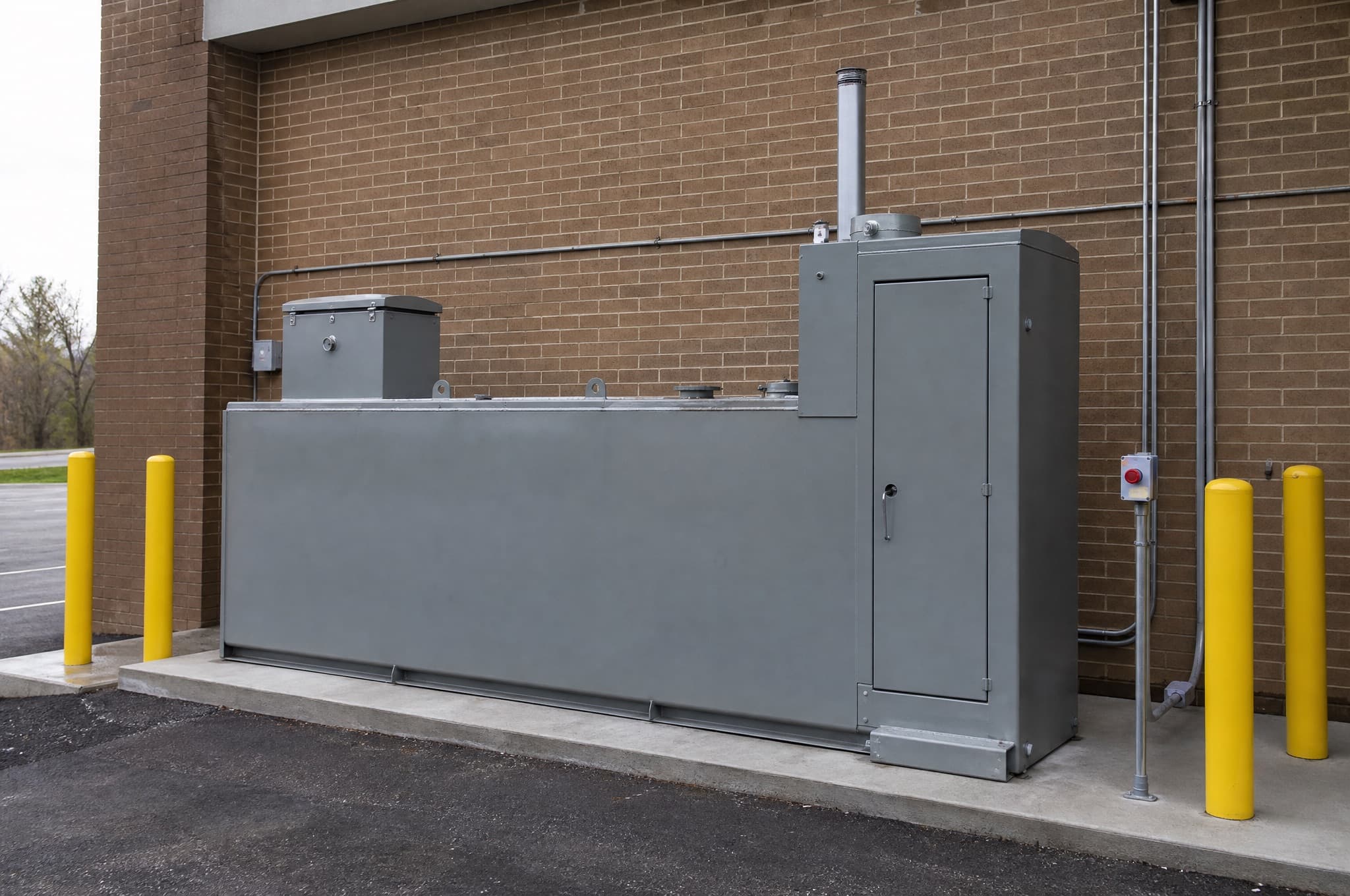
AST compliance: NFPA 30, fire code siting, containment and SPCC
Aboveground storage tank compliance is mostly fire code and containment. Where a UST is judged on what it does underground, an AST is judged on where it sits, how it is built, what happens if it is overfilled, and what contains a release. The fire code (NFPA 30 and NFPA 30A as adopted by the state) sets siting and construction. The environmental rules (federal SPCC at 40 CFR 112, NYSDEC Part 613, Virginia 9VAC25-91) set containment, inspection and planning obligations. On Long Island, SCDHS adds its own containment and overfill requirements and applies them to tanks other jurisdictions would not regulate.
At a glance
Managing Member · B.S. Civil Engineering, Georgia Tech · 15+ years in fuel systems · Updated September 2026
This page covers the rules that apply to commercial ASTs: fuel and diesel tanks, heating-oil tanks, waste-oil and motor-oil tanks at shops, and diesel tanks serving emergency generators. The federal requirements apply everywhere. The state and county layers vary by jurisdiction and by tank, and the sections below use New York, its county programs and Virginia as worked examples.
Who this applies to
- Fleet, municipal and commercial fueling with aboveground diesel or gasoline tanks
- Diesel ASTs, sub-base tanks and day tanks serving emergency generators
- Dealerships and repair shops with motor-oil, waste-oil and lubrication storage
- Heating-oil ASTs at commercial, institutional and multifamily buildings
- Owners converting from underground fuel-oil storage to aboveground tanks
- Facilities on Long Island subject to SCDHS Article 12 containment and overfill requirements
NFPA 30, NFPA 30A and fire code siting
Most state fire codes adopt the International Fire Code with amendments, and Chapter 57 (flammable and combustible liquids) and Chapter 23 (motor fuel dispensing) reference NFPA 30 and NFPA 30A. Together they govern where an AST can sit, how big it can be, how far it has to be from property lines, buildings, dispensers, public ways and other tanks, and what protects it from vehicle impact and fire exposure.
The separation distances depend on the tank type, the capacity and the liquid class, and they are different for a protected tank than for a plain steel tank. NFPA 30A also limits the capacity of ASTs at motor fuel dispensing facilities, both per tank and in aggregate for Class I liquids; the figures depend on the adopted edition, and the fire official's interpretation governs. Setbacks and capacity limits are the first thing a fire marshal checks and the hardest thing to fix after the tank is set.
- Setbacks from property lines, buildings, dispensers, public ways and adjacent tanks, scaled to tank type and capacity
- Vehicle impact protection (bollards or equivalent) where tanks and dispensers are exposed to traffic
- Emergency venting, normal venting and vent termination locations
- Emergency shutoff, signage and electrical classification at dispensing
- Capacity limits for ASTs at motor fuel dispensing facilities under NFPA 30A
- The local fire official is the AHJ for these items and issues the operational permit
UL 142 vs UL 2085
Two listings cover most commercial ASTs. UL 142 is the standard for steel aboveground tanks for flammable and combustible liquids, single-wall or double-wall. UL 2085 is the standard for protected aboveground tanks: a UL 142 primary tank inside insulation and a secondary containment shell, tested for two-hour fire exposure and for projectile and vehicle impact.
The choice matters for permitting. Fire codes allow protected tanks closer to property lines, buildings and dispensers than unprotected tanks, and some jurisdictions and applications require a protected or fire-resistant tank outright. A UL 2085 tank costs more and weighs more, but it often solves a siting problem that a UL 142 tank cannot. Double-wall UL 142 tanks provide built-in secondary containment without the fire rating. UL 2244 covers factory-assembled aboveground tank systems for motor vehicle fuel dispensing.
- UL 142: steel aboveground tanks, single-wall or double-wall; standard setbacks apply
- UL 2085: protected tanks with two-hour fire resistance and impact protection; reduced setbacks in most fire codes
- Double-wall construction provides secondary containment; a protected tank provides containment and fire resistance
- The tank listing is a design decision driven by the site, not a contractor preference
Not sure where you stand? Send what you have.
A photo, the notice, or a sentence about the site is enough to start. Matt reviews it personally and comes back with the likely path.
Spill containment and overfill prevention
Every AST needs two things regardless of size: a way to contain a release and a way to keep the tank from being overfilled. Containment is a dike or impervious containment area sized to the largest tank plus an allowance for precipitation, or a double-wall or protected tank that provides containment within the tank itself. Overfill prevention is an overfill prevention valve, a high-level alarm, a fill limiter or a combination, chosen to match how the tank is filled.
SCDHS requires new outdoor ASTs in Suffolk County to have impervious containment and diking around and under the tank sized to at least 110 percent of the largest tank, with controlled drainage, and a positive means of detecting an overfilling condition before any spillage can occur, with both visual and audible alarms at the most frequently manned point and the overflow point visible to the filling operator or an equivalent. Alternate designs are at the Commissioner's discretion. Other jurisdictions use different percentages and alarm requirements; the design has to match the code that applies at the site.
- Dike or containment area sized to the largest tank plus precipitation allowance, or double-wall or protected tank construction
- Controlled containment drainage: no open drain valves left in the dike
- Overfill prevention valve, high-level alarm or fill limiter matched to the fill method
- Fill point spill containment at the connection
- Suffolk County: 110 percent containment and visual plus audible overfill alarms at the manned point
Pump-filled tanks and the SCDHS treatment on Long Island
A gravity-filled tank is filled from a truck at a fill point at or near the tank, and the driver can usually see the vent or a gauge. A pump-filled tank is filled by a pump, either from the delivery truck under pressure or through a remote fill and transfer pump to a tank the driver cannot see. Pump filling changes the overfill risk because a pump keeps pushing product after the tank is full, and the operator may be nowhere near the overflow point.
Suffolk County treats this seriously. The Article 12 requirement for a positive means of detecting an overfilling condition before spillage, with visual and audible alarms where the filling operator is and the overflow point visible or equivalently detected, is applied through SCDHS plan review and its construction standards to remote-fill and pump-filled tanks. In practice that means the design has to show the high-level alarm at the fill location, an overfill prevention device that positively stops or limits flow, the containment, and how the fill operator will know the tank is full. Truck fill stands and transfer facilities have their own plan approval, spill monitoring and containment requirements under Article 12. Nassau and Westchester have their own expectations, and the fire code applies everywhere.
- Identify the fill method during design: gravity, truck pump, or remote fill with a transfer pump
- Show the overfill alarm and shutoff at the point where the fill operator stands
- Show containment at the tank and at the fill point
- In Suffolk, expect SCDHS to review pump-filled and remote-fill arrangements closely
SPCC, NYSDEC Part 613 and Virginia 9VAC25-91
Three environmental programs commonly reach ASTs, each with its own applicability test.
The federal SPCC rule at 40 CFR 112 is not triggered by a gallon figure alone. It reaches a non-transportation-related facility when its aggregate aboveground oil storage capacity is more than 1,320 gallons, counting containers of 55 gallons or more (or its completely buried storage is more than 42,000 gallons), and the facility could reasonably be expected to discharge oil to navigable waters or adjoining shorelines. A covered facility needs a written Spill Prevention, Control and Countermeasure plan, with secondary containment, inspections, training and recordkeeping. Qualified facilities can self-certify their plan in both Tier I and Tier II; the tier depends on the facility's characteristics, primarily whether any single aboveground container holds more than 5,000 gallons, not on who signs. A facility that does not meet the qualified-facility criteria needs a plan certified by a licensed Professional Engineer, which ZE coordinates.
NYSDEC Part 613 counts ASTs toward the 1,100-gallon aggregate PBS facility threshold, so a site with heating-oil and generator ASTs adding up to more than 1,100 gallons is a registered PBS facility with inspection, labeling, overfill, containment and closure obligations for its ASTs. Virginia regulates ASTs through DEQ under 9VAC25-91. Registration, pollution prevention and contingency plan requirements under that regulation vary based on the capacity of the individual tank and the facility's aggregate storage capacity, so confirm current applicability with DEQ rather than assuming one number decides it.
- SPCC: more than 1,320 gallons aggregate aboveground (55-gallon containers and up) plus a reasonable expectation of discharge to navigable waters; written plan, containment, inspections
- NYSDEC Part 613: ASTs count toward the 1,100-gallon aggregate PBS facility threshold
- Virginia 9VAC25-91: DEQ registration, pollution prevention and contingency plan requirements that vary with individual tank capacity and the facility's aggregate storage capacity
- Suffolk County: registration reaches nearly all petroleum ASTs, with narrow heating and standby-power exemptions that vanish inside Article 7 zones
Waste-oil and motor-oil tanks at shops
Dealerships, repair shops and fleet garages store new motor oil, waste oil and other lubricants in ASTs, often indoors. These tanks are frequently overlooked because no one thinks of them as fuel. The rules do.
Waste oil is petroleum for registration purposes and is treated as a waste, so exemptions written for heating oil do not apply to it. In Suffolk County waste oil and lubricating oil tanks are registered like any other petroleum tank, and indoor waste tanks have their own Article 12 provisions. Under NYSDEC Part 613, waste-oil and motor-oil tanks count toward the facility's aggregate capacity. Federal used-oil management standards at 40 CFR 279 apply to the handling and labeling of used oil. The fire code governs indoor storage of combustible liquids, including tank listing, venting, containment and separation from ignition sources. Waste-oil heaters and the tanks that feed them have their own listing and installation requirements.
- Waste-oil and motor-oil ASTs are regulated petroleum storage; the heating-oil exemptions do not apply to waste
- Indoor tanks need listed construction, venting to the outside, containment and fire code separation
- Registration with the county and NYSDEC where thresholds are met; DEQ in Virginia where applicable
- Used-oil labeling and handling under 40 CFR 279
Generator tanks and NFPA 110
Diesel tanks for emergency and standby generators are the most common AST ZE designs. They are also where fire code, environmental rules and the standby power standard overlap. NFPA 110 (Emergency and Standby Power Systems) sets the fuel supply requirements for the generator: the class of the system determines how many hours the on-site fuel has to run the load, which sets the minimum usable tank capacity, and the standard addresses day tanks, fuel transfer, fuel quality and maintenance. NFPA 37 covers the engine installation itself.
On the storage side, the tank is an AST under the fire code (a sub-base tank, a remote UL 142 or UL 2085 tank, or a bulk tank with a day tank), it needs containment and overfill protection, it counts toward SPCC and PBS aggregate capacity, and in Suffolk County the standby-power exemption from registration is limited to tanks under 1,100 gallons outside an Article 7 zone, with overfill requirements still applying. Generator tanks inside buildings and on roofs bring additional building code and fire code limits on capacity and location.
- NFPA 110 class and run time set the minimum usable fuel capacity
- Sub-base, remote and day-tank arrangements each have their own fill, transfer and overfill design
- Containment, overfill protection, venting and setbacks apply as with any AST
- Counts toward SPCC and NYSDEC PBS aggregate capacity; Suffolk registration unless narrowly exempt
- Indoor and rooftop tanks carry additional capacity and location limits
How ZE supports AST compliance
ZE designs AST systems to the fire code, the environmental program and the county code that apply at the site: tank type and listing, siting and setbacks, containment, fill and overfill arrangement, venting, piping, dispensing and the generator interface where there is one. For existing tanks, ZE evaluates the installation, identifies what does not meet current requirements, and designs and permits the corrections. Contractors build from the design, the fire official and county inspect, and the registrations and SPCC plan are brought current.
- Fire code siting and tank selection resolved during design
- Containment and overfill design matched to the fill method and the AHJ, including SCDHS pump-fill review
- SPCC plan preparation, with Professional Engineer certification coordinated when required
- Correction of existing ASTs: containment, overfill protection, relocation or replacement, permitted and inspected
Common questions
Do I need a UL 2085 tank or is UL 142 enough?
It depends on where the tank sits. Fire codes allow protected (UL 2085) tanks closer to property lines, buildings and dispensers than UL 142 tanks, and some applications and jurisdictions require a protected tank. If the site has room to meet the UL 142 setbacks, a double-wall UL 142 tank is usually the economical choice. If it does not, a UL 2085 tank often solves the siting problem. ZE makes that call during design, with the fire official's requirements in hand.
When does SPCC apply to my aboveground tanks?
Capacity alone does not decide it. SPCC applies when the facility is a non-transportation-related facility storing oil, its aggregate aboveground oil storage capacity is more than 1,320 gallons counting every container of 55 gallons or more, and a discharge could reasonably reach navigable waters or adjoining shorelines. Underground storage counts separately at 42,000 gallons. Generator tanks, heating-oil tanks, waste-oil tanks and drums all count toward the aggregate. A covered facility needs a written SPCC plan, self-certified by the owner when it meets the qualified-facility criteria (Tier I or Tier II) or certified by a licensed Professional Engineer when it does not.
What does SCDHS require for a pump-filled AST?
Article 12 requires new outdoor ASTs to have impervious containment sized to at least 110 percent of the largest tank and a positive means of detecting an overfilling condition before spillage, with visual and audible alarms at the most frequently manned point and the overflow point visible to the fill operator or an equivalent. SCDHS applies these through plan review and its construction standards to remote-fill and pump-filled tanks, so the design has to show the alarm at the fill location, the overfill device and the containment. Confirm the current construction standards with the Office of Pollution Control for the specific arrangement.
Is my waste-oil tank regulated?
Almost certainly. Waste oil is petroleum for registration purposes and is treated as a waste, so heating-oil exemptions do not apply. In Suffolk County waste-oil and lubricating-oil tanks are registered like any other petroleum tank. Under NYSDEC Part 613 they count toward the 1,100-gallon aggregate. The fire code governs indoor storage, and 40 CFR 279 governs used-oil handling and labeling.
How big does my generator fuel tank need to be?
NFPA 110 sets the run time by the class of the emergency power supply system, and the tank has to hold enough usable fuel to run the connected load for that time. Usable capacity is less than nominal capacity because of the unusable volume at the bottom of the tank and the fill limit at the top. Local codes, the owner's operational requirements and the fuel delivery schedule also factor in. ZE sizes the tank from the generator's fuel consumption at load and the required run time, then designs the fill, containment and overfill around it.
Can I convert my underground fuel-oil tank to an aboveground tank?
Yes, and it is one of the most common projects ZE designs. The new AST is designed and permitted as a new installation, with fire code siting, containment, overfill protection and venting, and the UST is closed under the applicable closure rules with notification, sampling, a closure report and deregistration. On Long Island both the AST installation and the UST closure go through the county.
Planning or correcting an aboveground tank?
Tell Matt Zambrano what the tank stores, how it is filled and where it sits. ZE will design it to the fire code, the environmental program and the county requirements that apply, and carry it through permit and inspection.